
Is Dynamic Neural Retraining System Legit?
A book review of Chasing Peace by Tom Rosshirt

I was in the Harvard Coop when I came across a new book, Chasing Peace: A Story of Breakdowns, Breakthroughs, and the Spiritual Power of Neuroscience. The author is Tom Rosshirt, a former White House speechwriter who worked in the Clinton Administration. What attracted me to the book is the endorsement by Dr. Howard Schubiner, an expert on psychological approaches to physical pain. I’ve written about Schubiner’s ideas in the memoir I’ve been writing about my recovery from seven years of psychosomatic pain.
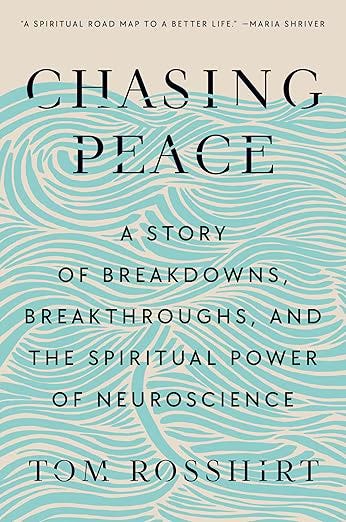
At first, Rosshirt’s book focuses on how disappointments can lead to anxiety and depression. But eventually, Rosshirt has symptoms that seem more biomedical, including brain fog, memory issues, and neuropathy. He went on a journey of eight years into chronic illness. Chemical and environmental sensitivities led him to move out of his home to a supposedly hypoallergenic apartment tailored especially for people with sensitivities. He also limited the places where he would go outside his apartment for fear of triggering a reaction. Yet his condition got worse. His trajectory was reminiscent of that of the character played by Julianne Moore in the 1995 movie, Safe. His recovery came when he joined a support group that took an approach created by Annie Hopper called Dynamic Neural Retraining System (a conversation between Hopper and Rosshirt can be found on Spotify). Rosshirt learned that avoiding triggers actually made his system more sensitive and more easily triggered by minute stimuli. Fear was the force magnifying his symptoms and sustaining his illness. His recovery came through a kind of exposure therapy during which he slowly and with a light-hearted attitude reintroduced himself to the environments he’d been avoiding.
When I searched for “Dynamic Neural Retraining System” on Google Scholar, it came up with 43 results, compared to an amazing 608,000 for “Mindfulness-based Stress Reduction.” So DNRS has not been well-studied and by no stretch can be said to be scientifically proven. Its creator, Annie Hopper, has the lived experience of recovery but does not list any academic qualifications in her bio. And yet Rosshirt’s experience reminds me a lot of my own experience with amplified pain. He references the relatively new but well-respected theory of predictive processing, which explains that the brain is not simply a passive receiver of sensations from the body but takes an active part in shaping them, something that often occurs unconsciously so that we don’t realize we’re doing it.
I find Rosshirt’s account credible. What I have learned from researching my book is that fear and anxiety can indeed amplify sensory stimuli until they are intolerable, and that replacing fear with confidence in one’s health can be therapeutic. Of course, before doing that, it’s important to be checked out by a physician, as Rosshirt was many, many times over his eight years of illness.
One interesting aspect of Rosshirt’s health odyssey is that he practiced Vipassana meditation for years but it was not sufficient to lift him out of his health anxiety. This is reminiscent of a story told by Ronald Siegel in his book, Back Sense. Siegel had a disabling bout of back pain that was cured when he came to accept the views of Dr. John Sarno, that much chronic pain is due to emotional rather than physical issues, and that this finding applied to him. Siegel notes that he had a meditation practice during his period of disabling back pain but just paying attention to the pain non-judgmentally was not enough to recover from it. He also had to deal with the deeper fears that were the source of the pain. I’m a big fan of meditation, but as I wrote in a previous post, the evidence that meditation alone can cure anxiety and depression, let alone apparently physical conditions caused by anxiety and depression, is rather thin.
Toward the end, Rosshirt’s book gets a little religious. This section did not work for me but may for other readers. I do think secular people sometimes pooh-pooh the power of faith to their detriment but as I see it, the power of faith is the power to employ the brain’s predictive processing to maximize health.
The other day, I asked my religiously-raised in-laws what they think others are missing out on by not practicing religion. We had a really fascinating conversation, some of the answers surprising me. Your comment about pooh-poohing faith has triggered another surprising answer to that question; the faithful are probably better equipt to cede control (or the illusion of it) to the benefit of their health. Sure, there are ways that can go wrong, but neurologically speaking, it--like you said--enables them to use the brain's predictive power for good. While a religious person may say that their health is in a greater power's hands, I can see molding that faith into something a little different--a reminder that the human body is complicated but more robust than we may think. At the very least it is adaptable.