
Is Mindfulness Bogus?
Have I been fooled all along?

Since I’ve led mindfulness meditations for more than a decade, there’s a danger I’ll get defensive in discussing an episode of The Science Fictions Podcast where Stuart Ritchie dismisses it with a “And hopefully, maybe we can put it to bed. This is not something that works.” His podcast partner, Tom Chivers, sensing that Stuart has made an overly broad conclusion, jumps in saying, “As always with stuff like this, if it works for you, great. If you enjoy it, great. If you find it reduces your stress, great.”
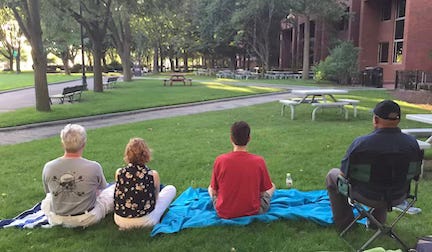
It does work for me and I think it’s pretty great. For me. I know it doesn’t work for some other people, including my wife, who has never been able to get much out of mindfulness despite hearing me talk about it and being my first reader for decades. This bothered me a bit until I went on a seven-day meditation retreat some years ago and the teacher happened to mention that she couldn’t get her wife to meditate. It may be that only a minority of people are apt to get significant benefits from meditation. That may explain why studies of whether meditation helps with mental health don’t find much of an effect. Contemporary mindfulness meditation stems from Buddhism, but a large portion of Buddhists in Asia do not meditate and even among those who do, it’s unclear how many do it for something akin to “mental health.”
The hosts of The Science Fictions Podcast are Stuart Ritchie, a psychologist who has left academia and landed in AI, and Tom Chivers, a science writer, who wrote a book I enjoyed, Everything Is Predictable. They are not meditation experts. What they do know a lot about is the proper methodology to use in scientific research. Stuart’s book, Science Fictions: How Fraud, Bias, Negligence, and Hype Undermine the Search for Truth, exposes bad science.
So is meditation research bad science?
Stuart and Tom praise a 2017 paper published by mindfulness researchers and others in the mindfulness field that raises questions about the quality of research done up to that point. I’m familiar with a number of the paper’s authors, having interviewed two of them for articles unrelated to this paper and having been interviewed by Ted Meissner on his Secular Buddhist podcast. One problem is that a number of the studies that find benefits to mindfulness programs compare the people taking the program to people on a wait-list for the program. This means that attending a mindfulness program is better than doing nothing. But is the benefit due to mindfulness or some other factor, such as getting out of the house and meeting people?
When mindfulness programs are compared to what are called “active controls,” that is, other programs (such as a health class) where people interact with instructors but do not learn meditation, the benefits of mindfulness are not so apparent.
There are a number of individual studies that show benefits. But there have been many, many studies. When you bring them all together, on the whole the results are not impressive. A meta-analysis is a way of pooling the results of studies together in order to statistically analyze them. This 2021 meta-analysis of mindfulness-based programs found that “compared with doing nothing, mindfulness reduces anxiety, depression, and stress, and increases well–being” but when compared to other programs that aim to improve mental health, mindfulness programs were no better nor any worse.
That’s not really a slam. It does undercut the hype that mindfulness is some sort of panacea, but suggests that it’s reasonable to include mindfulness among a menu of options for people seeking help.
As for me, I attended my first meditation class forty years ago after recovering from a psychosomatic condition. I hoped it would help me with my anxiety. I’m not sure it did, but what I got out of it was something unexpected. I learned how to silence my thoughts.
Interestingly, the tip sheet from the UK National Health Service referenced in the podcast says, “It might be useful to remember that mindfulness isn’t about making these thoughts go away, but rather about seeing them as mental events that come and go.”
My experience is different than that. When I meditate, my inner voice goes quiet. When I open my eyes and for as long as that inner quiet lasts, I’m much more attuned to sights and sounds around me. I find that delightful. But anxious thoughts do return eventually, and even after forty years of meditating, it’s not easy to see them as mental events that flitter by like clouds. So meditation doesn’t cure my anxiety, but it does bring me temporary peace.
It was more than twenty years after I started meditating that I experienced another, very positive effect. It’s not the “incredible state of bliss” that Stuart and Tom say some Silicon Valley mindfulness proponents claim to have. But there is a wow to it. As I’ve written about here, just walking in my neighborhood, I can feel a sense of wonder about my visual surroundings that I previously only felt when visiting, say, national parks.
For serious mental health problems, I don’t believe mindfulness is as useful as psychotherapy. But it is helpful for many people in dealing with day-to-day stresses. Beyond that, it can bring moments of joy and zest to one’s life. For me, that makes it more than worth the effort.